Tag Archive for: distributed transformers

Transformer voltage transformer: key role and practical application

Without transformers, electricity could not travel efficiently and safely from the power station to your socket, nor would most industrial machinery work. But all functionality depends on one key principle. It is voltage conversion.

How transformers change voltage level

A transformer is essentially a static device that transfers electrical energy from one circuit to another without direct electrical contact, using a magnetic field. The principle of electromagnetic induction is the basis for voltage transfer in a transformer , discovered by Michael Faraday. When an alternating current passes through the primary winding, it creates a constantly changing magnetic field in the core. This changing field passes through the secondary winding and induces a voltage in it. What the output voltage level will be depends entirely on the ratio of the number of turns of the primary and secondary windings. This relationship defines the key parameter of the transformer: the transformation ratio.

Voltage units and conversion of voltage units

When discussing voltage conversion, we cannot avoid the fundamental physical quantity: electrical voltage. The basic unit of electrical voltage in a system is the volt, named after the Italian physicist Alessandro Volta. The conversion or transformation of voltage units is, of course, necessary for the precise design and operation of networks. When we need to determine what voltage a transformer will handle, we always work in consistent units: volts, millivolts, kilovolts or megavolts.
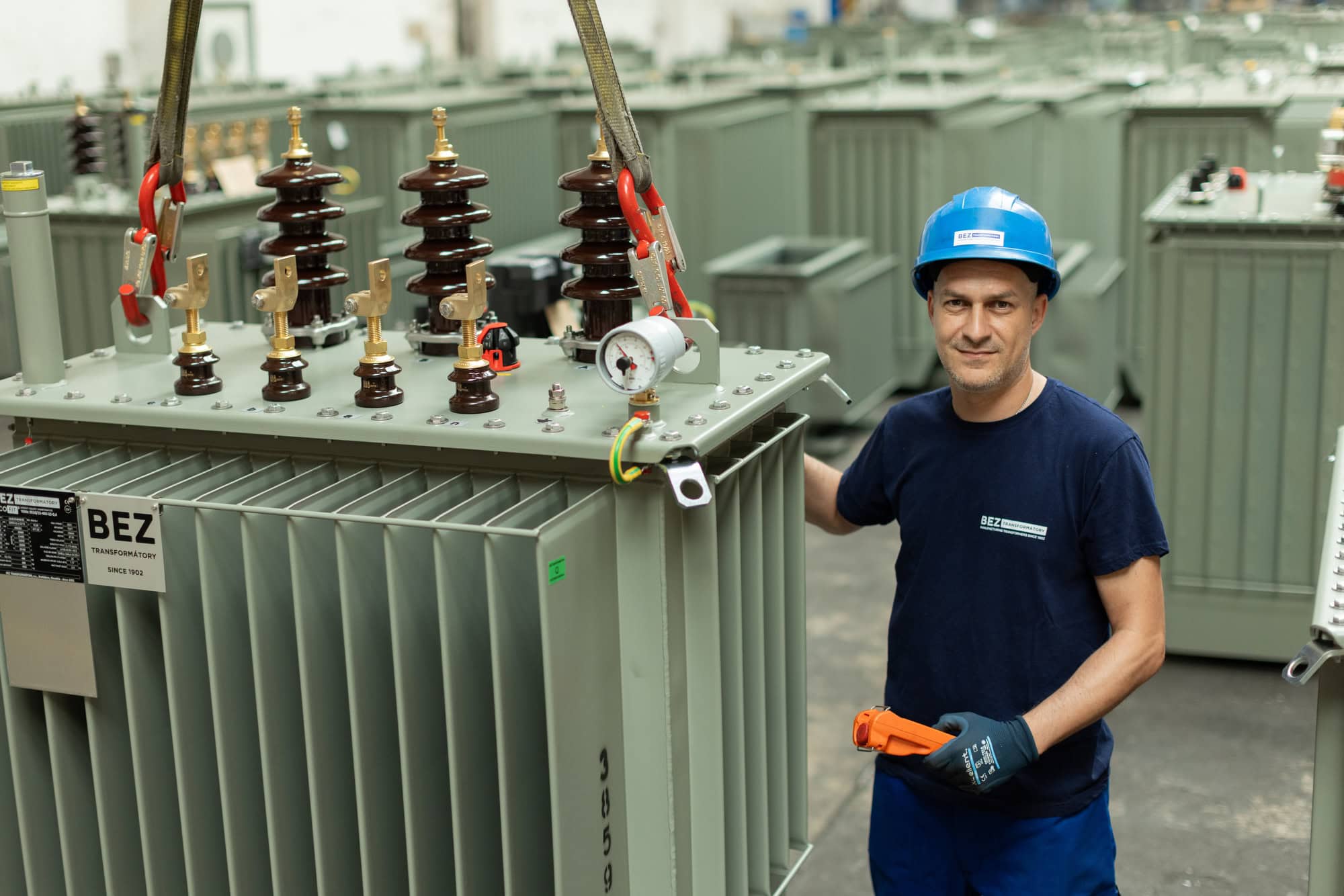
step-up and distribution transformers

From mains to USB charger

The role of transformers is divided into two main categories: strategic (in the power sector) and local (in industry and households). At BEZ TRANSFORMÁTORY, we specialize in distribution transformers, which are critical in the transition between the grid and the end consumer.

The key reason for voltage transfer is to minimize transmission losses. The higher the voltage, the lower the current, and the lower the heat losses on the lines. Boosting transformers operate in the vicinity of power plants . Electricity is generated at lower voltages (e.g. 10-25 kV). Step-up transformers immediately convert it to very high transmission voltages (e.g. 110 kV, 220 kV, 400 kV) for efficient long-distance transmission. As the power approaches populated areas, distribution transformers step in . These carry out a gradual step-down.

In the industrial environment, voltage conversion is important for powering specific machines and improving safety. Finally, also in solar parks and wind turbines, transformers raise the generated voltage to grid level so that it can be distributed efficiently.

Transformers are part of your life all the time. For example, you will find a distribution transformer in front of your house that reduces the voltage from 22 kV to the standard 230 V for your home. Most of the home voltage transfer is then provided by small adaptors (which contain miniature transformers or electronic switching power supplies). Almost every device that does not run directly on 230 V (mobile phone chargers, laptop chargers, LED lighting) needs a step-down transformer or electronic substitute to safely reduce the voltage (e.g. from 230 V to 5 V for USB or 12 V for lighting).

Voltage transfer is more than just a technical operation

It is the pillar on which modern electricity infrastructure stands. It allows us to transmit electricity with minimal losses while delivering it safely to every device, from a huge production line to the smallest LED bulb.
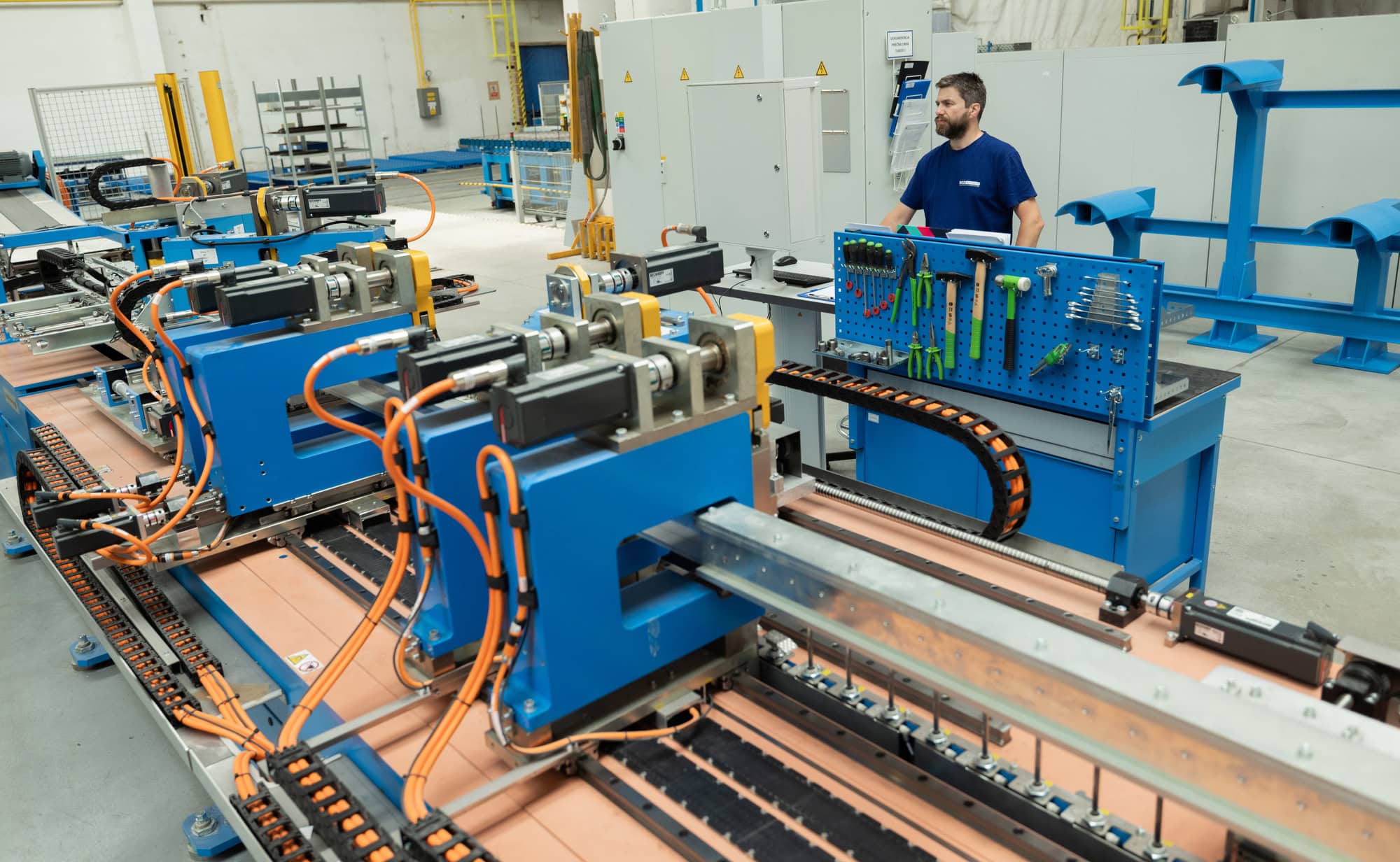
voltage transfer by transformer

As the only manufacturer of distribution transformers in Slovakia with more than 120 years of tradition, BEZ TRANSFORMÁTORY ensures that this critical voltage transfer takes place reliably and efficiently throughout the distribution network, making it a key link in the stability of the energy infrastructure.
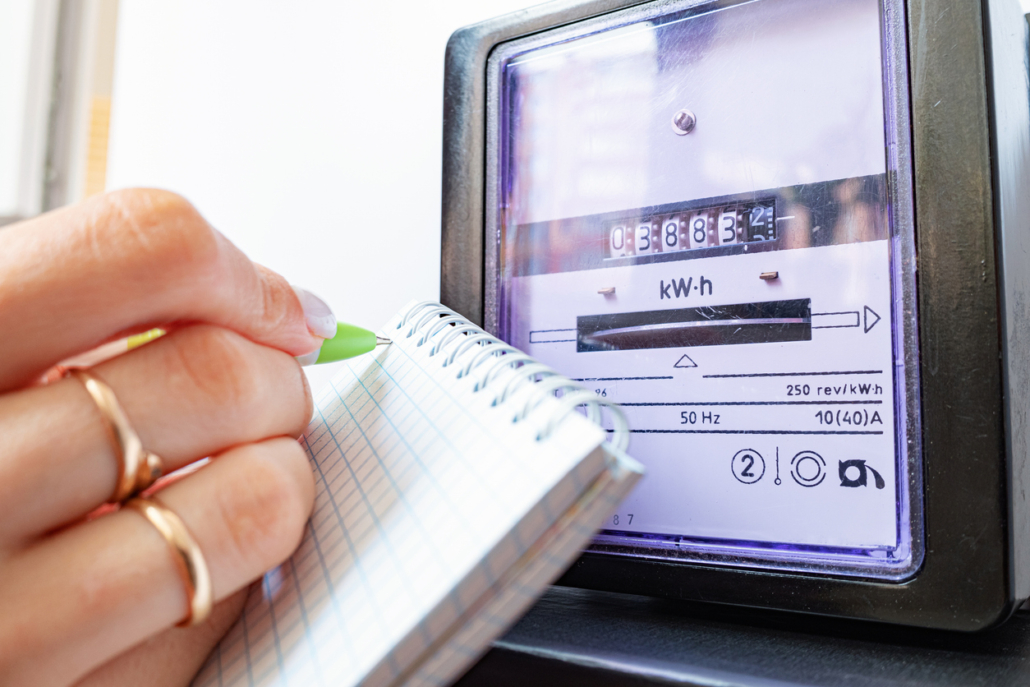

Transformer losses: why they are important and how to minimize them

Every transformer, even the most efficient, loses some energy in the form of heat. These transformer losses, small as they may seem, accumulate in the long run and lead to higher financial costs and a negative impact on the environment. Let us therefore look together at the different types of losses, their causes, and especially the methods of minimising them.

Transformer losses have a direct impact on the efficiency and cost of operation

Although transformers are designed to minimize losses, they cannot be completely avoided. However, several types of losses are known:

  • No-load losses occur in the iron core of the transformer. We therefore call them iron losses. They reduce the efficiency of the equipment even in the idle state. They are load-independent losses. Their minimization therefore plays a very important role in long term grid connection and in transformers that operate in standby mode for long periods. Long-term operation with high no-load losses can lead to significant financial losses.
  • Short-circuit losses ( or winding losses) are due to the resistance of the transformer windings through which current flows. These losses are directly dependent on the load on the equipment – the higher the load, the higher the losses. Therefore, it is extremely important to design the transformer with a good quality conductor.

Minimise transformer losses: increase efficiency and reduce operating costs

There are various techniques and technological solutions aimed at reducing dead, short and no-load losses:

  • Optimization of core design: the core plays a significant role in the generation of idle losses. However, high quality materials (silicon steel) can reduce losses by reducing core losses and improving the overall efficiency of the device. It is also important to reduce eddy currents, which can be achieved by laminating the core. The core consists of thin sheets separated by an insulating layer.
  • Winding design optimization: losses due to conductor resistance can be reduced by using lower resistance materials. Optimisation of the winding geometry is also important. Proper winding layout can improve the efficiency of the transformer.
  • Use of modern technology: modern technology can also solve the problem of a transformer connected to the grid for a long time. There are materials with lower hysteresis and eddy losses and also modern control systems that optimize the load on the equipment in real time.
electricity depreciation

Transformer losses and their impact on operating costs and the environment

The presence of losses directly reduces the efficiency of the device. Losses in the iron (idle) reduce efficiency even at low load or even in standby mode. Losses in the windings (shorted) increase with load. Higher transformer efficiency means lower losses, and this translates into lower power consumption and more stable operation. Conversely, higher losses in the transformer increase power consumption. In addition, they can increase both cooling and maintenance costs. This is because losses are converted into heat that needs to be dissipated, and this requires an efficient cooling system. Prolonged exposure to higher losses can reduce service life, which in turn leads to more frequent repairs.

Energy losses in transformers also indirectly affect the environment. The amount of energy consumed has an impact on greenhouse gas emissions. The environmental burden is also increased by the more frequent disposal of transformers with shorter lifetimes due to high losses.

Investing in efficient transformers will bring significant long-term benefits

Although the initial cost of modern and low-loss transformers may be higher, ultimately minimizing losses leads to significant energy savings, reduced operating costs, and extended equipment life. Higher upfront costs are also recovered after just a few years in the form of lower utility bills and reduced operating expenses.

saving on electricity, transformer losses, minimizing losses

Minimising losses leads to long-term energy and cost savings. In continuous operation, energy savings can represent significant financial benefits. The benefits of quality transformers include fewer faults and downtime, which means lower repair and equipment replacement costs. More reliable operation with less risk of unexpected failures is just one of the significant benefits of extended lifetime.

Ak hľadáte efektívne a spoľahlivé riešenia, neváhajte kontaktovať spoločnosť BEZ TRANSFORMÁTORY. Pomôžeme vám vybrať najvhodnejšie zariadenie, pričom zohľadníme vaše špecifické potreby. Poskytneme vám aj komplexné poradenstvo v oblasti minimalizácie strát a optimalizácie energetickej účinnosti.